Key Actions
- ▹Rehearse your opening 60 seconds (scope, clarifying questions, success metric).
- ▹Know the evaluation axes: requirements, API contracts, data model, scale math, resiliency.
- ▹Practice narrating trade-offs out loud with a timer.
System Design Interview Labs
20 real case studies — URL shorteners to LLM inference serving — each with interviewer dialogue, an architecture blueprint, and a flow diagram you can narrate out loud.
20
Case studies
5
Categories
14
Flow blueprints
20
Free to start
URL Shortener
Design a highly scalable service like Bitly to shorten long URLs into manageable links.
OpenRide-Hailing Service
Architect a real-time platform like Uber to connect riders with drivers and manage trips.
OpenVideo Streaming Platform
Design a massive-scale system like YouTube for video uploading, processing, and streaming.
OpenFree access
100%
of case studies open without membership
Playbook Section
Understand expectations before touching diagrams.
Review the FAANG evaluation rubric, pacing, and storytelling patterns. The interviewer wants clarity, not perfection.
Key Actions
Suggested Resources
The method
You don't need 15 memorized architectures — you need one repeatable way to attack a problem you've never seen. Every case study on this site follows these ten steps, so the pattern transfers to whatever your interviewer asks tomorrow.
01
Clarify
What are we building? Restate the problem in one sentence.
02
Scope
What are we NOT building? Cut features out loud.
03
Estimate
Users → QPS → storage → bandwidth. Let one number drive the design.
04
Model
Entities and API contracts before any boxes.
05
Architect
Draw the simplest system that satisfies the requirements.
06
Deep dive
Pick the 2–3 hardest problems and go deep only there.
07
Scale
Find the bottleneck. Fix that one, not everything.
08
Failure
What happens when each component breaks? Blast radius and recovery.
09
Trade-offs
Explain why this design — and what you gave up for it.
10
Summarize
Walk the interviewer through the final design end to end.
Learning journey
Follow the stages in order. Each stage assumes the muscles built by the one before it.
Progression, not memorization
Never open with the final diagram. Start simple and let each new component earn its place — interviewers score the reasoning between levels, not the boxes.
Level 1 — Simple
Client → API → DB
Correct for thousands of users. Start here out loud — it proves you scale on evidence, not habit.
Level 2 — Production
Client
  ↓
Load Balancer
  ↓
API (n instances)
  ↓
Cache → DB
The LB exists for deploys and instance failure; the cache exists because reads dominate. Each box has a stated reason.
Level 3 — Scale
Client
  ↓
CDN / LB
  ↓
Services (split by domain)
  ↓
Cache tier
  ↓
Partitioned DB
Partitioning appears only when one primary provably cannot hold the write volume. Services split along team and failure boundaries.
Level 4 — Global
Users
  ↓
Global routing (GeoDNS/Anycast)
  ↓
Regional services
  ↓
Regional caches
  ↓
Replicated data
Regions exist for latency and jurisdiction, not vanity. Now consistency between regions is your hardest problem — say so.
Case Study
Design a highly scalable service like Bitly to shorten long URLs into manageable links.
🎬 Video walkthrough · Hello Interview
Client
Edge POP
Redis
Case Study
Architect a real-time platform like Uber to connect riders with drivers and manage trips.
🎬 Video walkthrough · Hello Interview
Clients
API Gateway
Case Study
Design a massive-scale system like YouTube for video uploading, processing, and streaming.
🎬 Video walkthrough · NeetCode
client
upload gateway
signed URL (S3/GCS)
Case Study
Ship a critical OS update to 500M devices within 5 days.
🎬 Video walkthrough · ByteByteGo
Device
Update Gateway (global
API service
Case Study
Design Spotify-scale music streaming with personalized playlists and offline sync.
🎬 Video walkthrough · IGotAnOffer: Engineering
Ingest pipeline
object storage +
CDN distribution
Case Study
Design Twitter-scale microblogging with timelines, fan-out, and moderation.
🎬 Video walkthrough · NeetCode
Tweet ingest
metadata DB (Cassandra) + search index
Case Study
Design a platform to train and serve large language models as an API.
🎬 Video walkthrough · ByteByteGo
Global API gateway
auth
safety policy
Case Study
Design Windsurf/Codex: an AI coding assistant integrated with IDEs.
🎬 Video walkthrough · Cursor team with Lex Fridman
IDE plugin
context service
storage (object store
Case Study
Design LinkedIn-scale networking, feeds, and recruiting tools.
🎬 Video walkthrough · IGotAnOffer: Engineering
Profile service writes to graph DB
search index
Case Study
Design GitHub-scale repositories, pull requests, and CI integrations.
🎬 Video walkthrough · Gaurav Sen
Git front end
repo storage
blob store
Case Study
Design Netflix-scale SVOD with personalization and Open Connect.
🎬 Video walkthrough · Exponent
Ingest
encoding
DRM
Case Study
Design a platform that coordinates fleets of autonomous LLM agents — planning, tool use, memory, and guardrails at scale.
🎬 Video walkthrough · AI Engineer
Planner agent
Orchestrator
Worker agents
Case Study
Design a retrieval-augmented generation system: chunking, embeddings, vector search, and grounding an LLM's answers in your own data.
🎬 Video walkthrough · ByteMonk
Ingestion pipeline
Vector index
Hybrid retrieval
Case Study
Design the serving layer that runs a large language model in production: batching, KV cache, GPU autoscaling, and latency SLOs.
🎬 Video walkthrough · ShowOffer
Router/gateway
Continuous-batching scheduler
KV cache manager
Case Study
Design a messaging service delivering billions of messages a day with end-to-end delivery guarantees.
🎬 Video walkthrough · Gaurav Sen
Case Study
Design a ticket-booking system that survives 10 million fans hitting one on-sale at the same second.
🎬 Video walkthrough · Hello Interview
Case Study
Design a file sync service: upload once, appear everywhere, survive laptops that lie and networks that die.
🎬 Video walkthrough · Hello Interview
Case Study
Design a distributed rate limiter — the beginner-friendly question that still exposes senior-level thinking.
🎬 Video walkthrough · Hello Interview
Case Study
Design a polite, distributed crawler that fetches billions of pages without DDoSing the internet.
🎬 Video walkthrough · Hello Interview
Case Study
Design real-time collaborative editing — concurrent cursors, conflict-free merging, and offline edits.
🎬 Video walkthrough · Hello Interview
20 case studies come with a full walkthrough from the people who do these interviews for a living — Hello Interview, NeetCode, Gaurav Sen, ByteByteGo, IGotAnOffer and Exponent. Try the prompt first; the video is the debrief.
 59 minBeginner System Design Interview: Design BitlyHello Interview
 1h 3mDesign Uber — System Design Interview breakdownHello Interview
 26 minDesign YouTube — System Design InterviewNeetCode
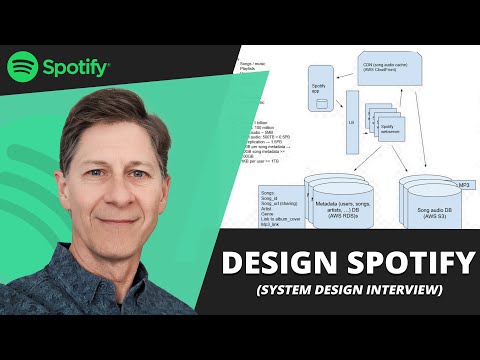 42 minGoogle system design interview: Design SpotifyIGotAnOffer: Engineering
 26 minDesign Twitter — System Design InterviewNeetCode
 25 minWhatsApp System Design: chat messaging systemsGaurav Sen
 27 minSystem Design Interview: Design NetflixExponent
 58 minDesign Dropbox or Google DriveHello Interview
 55 minDesign a Distributed Rate LimiterHello Interview
 1h 5mDesign a Web Crawler — System Design InterviewHello Interview
 15 minReal-Time Collaboration ExplainedHello Interview
 58 minSystem Design Interview: Design TicketmasterHello Interview
 52 min"Design LinkedIn" — system design mockIGotAnOffer: Engineering
 37 minSystem Design of GitHub Code SearchGaurav Sen
 15 minHow to Build a Scalable RAG System for AI AppsByteMonk
 40 minHow LLM Inference Actually WorksShowOffer
 18 minThe Multi-Agent Architecture That Actually ShipsAI Engineer
 10 minTop 5 Most-Used Deployment StrategiesByteByteGo
 21 minHow the Cursor code editor worksCursor team with Lex Fridman
 7 minHow ChatGPT Works Technically | ChatGPT ArchitectureByteByteGo
URL Shortener
Design a highly scalable service like Bitly to shorten long URLs into manageable links.
Ride-Hailing Service
Architect a real-time platform like Uber to connect riders with drivers and manage trips.
Video Streaming Platform
Design a massive-scale system like YouTube for video uploading, processing, and streaming.